

6 Strength Training Methods
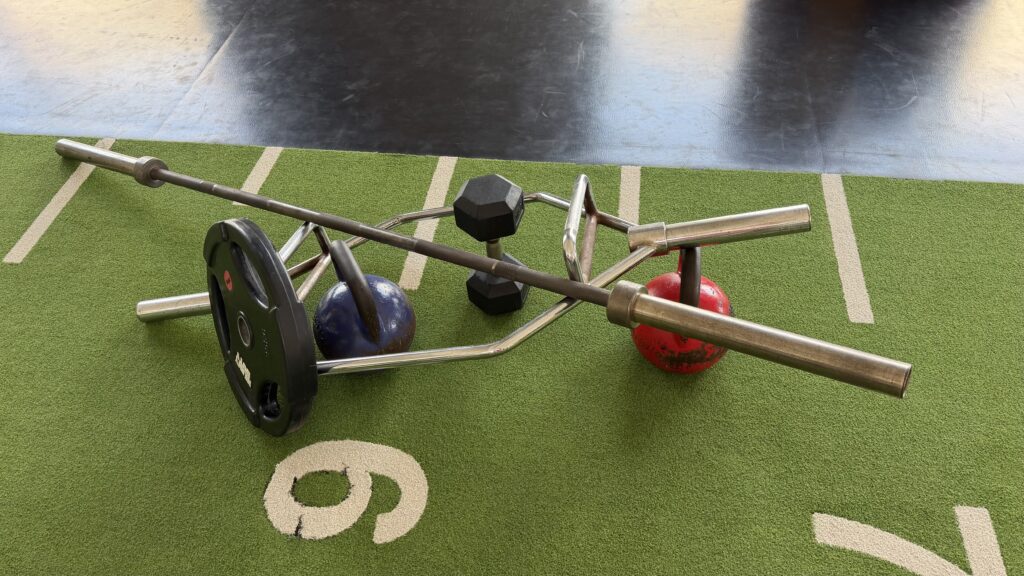
Strength is something that often gets neglected in the sport of tennis.
And even when it’s part of the program, it still tends to reflect old-school methods — heavily focused on traditional lifts like the squat, bench press, and deadlift.
Now, don’t get me wrong — there’s absolutely nothing wrong with these exercises. They are effective and powerful tools.
But when we’re training rotational sport athletes like tennis players, using single-plane, dominant movements in the gym, isn’t the best approach.
Back at the beginning of my coaching career, strength training meant to me one thing:
Get my athletes stronger by lifting more weight. It was all about force production together with good biomechanics.
But over time, my perspective evolved in the way that now I look at strength differently, not just as a way to increase force production, but as a way to create:
First: Good stiffness as a protective factor for our joints and tendons
Second: To facilitate Control over body positions on the court, which allows athletes to better own different challenging positions while playing, and
Third: The ability to improve movement capacity and movement variability
So based on all of that, here are six key strength training approaches I believe we should use in the sport of tennis today:
- Bilateral strength
- Unilateral strength
- 3D strength
- Positional or End-range strength
- Eccentric strength
- Coordinated strength
Let’s talk briefly about each one of these 6 strength training approaches
First is Bilateral Strength
This is your traditional strength foundation — exercises like squats, deadlifts, or bench presses done with both limbs working together.
It helps build overall force production and structural integrity, and these exercises have their place and time during almost every athlete’s career.
Now, for a moment, imagine a stiff player with reduced mobility, most probably with a wide ISA. With this type of athlete, you should be careful with this kind of strength training approach simply because it will make him even stiffer and, with that, will decrease his quality of movement and, over time, create a greater chance for injury.
For experienced athletes with a high volume of accumulated “mileage”, bilateral strength training creates more risks than potential benefits. While strength training is essential for reversing sarcopenia and maintaining bone density, constantly chasing high-intensity, heavy, bilateral lifts can lead to chronic injury, joint degeneration, and reduced training longevity due to the already high wear and tear on their joints and ligaments.
On the other hand, young, physically underdeveloped players, who are at their hormonal peak levels, can benefit much more from this approach, especially the ones who have increased joint range of motion and the ones who are generally considered unstable.
Second strength training approach is Unilateral Strength
Now, this is where things get more sport-specific.
Tennis is like 90% of sports, almost entirely played on one leg at a time — think about accelerating to reach for a drop shot, side shuffling, changing direction.
Single-leg movements put higher demands on ankle/hip/trunk stabilization, targets more frontal/transverse plane of motion. Unilateral training directly targets one limb at a time, which can improve strength in that limb and reduce side-to-side imbalances. This means better transfer to sport movements that are single leg in nature (e.g., accelerating, cutting, jumping off one leg).
Mike Boyle points out what he terms the “bilateral deficit” — the phenomenon where the sum force of unilateral efforts is higher than the force produced in a bilateral effort.
Exercises like rear-foot elevated split squats, step-ups, single-leg deadlifts, 1 arm pushes and pulls help develop balance, coordination, and strength in asymmetrical positions that reflect the demands on the court.
Another advantage of this approach is that you can load them heavy with less stress on skeletal system (think heavy back squat compared to RFESS while holding two KB by your sides)
Third is what we called 3D Strength
This approach is more about internal load. To explain this, let’s compare two split squats, where in the first one you hold two 16kg KB, one in each hand. In the 3D example of the same exercises, you would keep one KB of 32 kg in the contralateral or ipsilateral hand. You will notice that the 3D feels much harder to do, even if mathematically we used the same weight. This is because we need more body tension and proximal stability to execute a biomechanically correct split squat.
Here we are talking about irradiation, which in the simplest means increased co-contraction demands that limit extra motion, feeds strength to the joints we’re training, and in general teach joint control. This “irradiation” effect can improve overall body tension, stability, and control during exercises, leading to increased strength and power outputs.
With less external load, 3D strength training can be a good strength stimulus option at times close to a competition, or even during a tournament on a day off because of much lower fatigue accumulation.
This approach has an advantage for stiff athletes, because of higher proximal stabilization demands, directly addressing the multi-planar demands of sports while increasing joint mobility and functional flexibility
Stiff athletes often struggle to break force. 3D training trains the body to absorb deceleration forces (down, lateral, and rotational) simultaneously, strengthening tendons and ligaments to handle the chaotic, multi-directional nature of sports
The fourth one is Positional / End-Range Strength
Positional or end-range strength refers to an individual’s ability to develop and maintain strength in specific joint angles or body positions.
In tennis, that could be a deep lateral lunge, a stretched posterior shoulder during a serve follow-through phase, or the start of a recovery step from a difficult defensive position.
Training at the end ranges improves joint integrity, resilience, and control under stretch. This approach combines isotonic and isometric muscle actions. Imagine doing a lateral split squat: descend into the down position, hold that end-range position isometrically for 5 seconds, and come back to the starting position.
Another example can be when isometrically staying in a split stance, more like a tennis closed stance position, and doing landmine presses. Here, the lower body serves as an anchor for the moving upper body.
End-range strength is recommended for hypermobile athletes because it provides active stability in the deep ranges of motion, where these athletes lack control over the excessive range of motions they possess.
Under this type of strength training approach falls classic isometric training, or so-called PIMAs (Pushing Isometric Muscle Actions) and HIMAs (Holding Isometric Muscle Actions).
The fifth one is Eccentric Strength
This type of training focuses on the lengthening phase of a muscle contraction and is one of the most powerful — and often underused — tools in strength and conditioning.
There is one important consideration about eccentric movement and training in the world of tennis, which I found through force plate testing.
Force Plates measure vertical ground reaction forces over time — essentially how much force an athlete absorbs and produces during movement. What I found is that the best tennis movers score better in all eccentric variables (eccentric velocity, eccentric power, eccentric braking RFD)
Isoinertial training stimulates this eccentric muscle action. After the end of concentric muscle action and during the transition period, there is almost zero resistance in the first 10-15° of the eccentric phase, but after that you get “hit” with strong eccentric forces. When it comes to joint position and angles, this “eccentric punch” is happening around angles you find yourself at the court and want to change direction or re-accelerate!
Moreover, when you understand that for example, Novak Djokovic, during 2025 US Open was covering 9.99m per point but at the same time was doing 4.5 of change of direction per every point, you can understand the importance of deceleration prior to briefly stopping and then re-accelerating.
Last but not least is Coordinated Strength
This is the ability to synchronize multiple joints and muscle groups to move efficiently. CS is a concept we learned from Frans Bosch, and it reflects real sport situations where the body must coordinate the upper and lower parts, rotation, and timing. Regarding Bosch, movement is improved not by exploring its core (think perfect technique), but by exploring its limits (think where it breaks down). The main idea of this approach is to use self-organization patterns to build anti-fragile athletes. For tennis, we can use equipment like 3D band, ViPR, and med balls to reinforce movement patterns with specific intent, combined with chops and lifts as a rotational stimulus.
It’s not just strength — it’s strength with timing and rhythm.
To wrap up today’s episode, I would say that each of these six methods plays a specific role, and some of them should be used more, some less, depending on which kind of athlete you have in front of you.
Combined, they build strong, adaptable, and sport-ready tennis athletes — not just gym-strong bodies. Here we’re moving beyond the barbell, beyond just numbers on the weight stack, into a space where strength supports skill, protects the athlete, and enhances performance.
Remember that tennis is a rotational sport; every time we make a strength training program, we should ask ourselves how much strength this athlete really needs, which type of strength stimulus he can benefit the most from, creating the fastest transfer to the tennis court.