

Tennis Developmental Youth Training Model

Tennis Developmental Youth Training Model
The Tennis Developmental Youth Training Model (TDYTM) represents a framework for the development of physical skills, and it’s based on chronological and biological age of every athlete. Here I want to highlight one important consideration, I’m not talking only about chronological age, we need to take in consideration biological age as well. Meaning, we have seen many times tennis player of age 14 that looks almost like 18, on the other hand I was working with now, one of the top male tennis players who at age 16 was looking like a 13/14-year-old boy. So, while be aware of chronological age of a player standing in front of you, what is more important is how much his body has biologically matured. Biological age refers to the biological status or maturity of the athlete depending on whether they are a pre-adolescent, adolescent, or an adult.
In comparison to chronological age, the classification of biological age is far more complex. The biological status of a young athlete is typically done by calculating the maturity offset of the individual (predicted years from peak height velocity) by using anthropometric measures – in most circumstances by using age, standing height, sitting height and leg length (1). Two factors are proposed as markers of human development: peak height velocity (PHV) & peak weight velocity (PWV). However, what we know is that kids get taller and heavier across a wide variety of ages; some kids are big from a young age, others aren’t. Some experience their significant growth spurt late in their teens, others much earlier. Individual differences in height & weight growth rates (probably related to genetics) are always at play.
Personally, I like to rely on a doctor opinion who makes an x-ray on growth plates and determine how much they are open, which helps to determine in which phase of growth the athlete is in.
Windows of opportunity
The key concept inside the TDYTM model is based on so called “windows of opportunity “.
A window of opportunity presents a particular stage in human development corresponding to chronological / biological age, where all athletes at that age should train that skill to maximize their trainability of it. 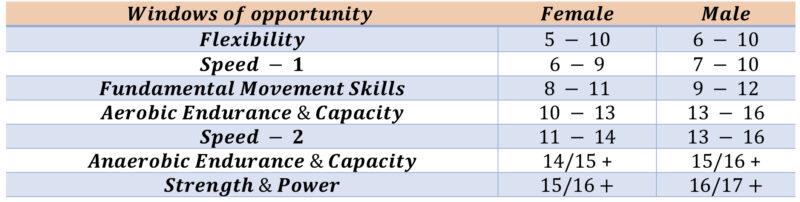
Concept of “windows of opportunity” is an interesting model, but it doesn’t account for individual differences in physical development or motor and physical skills. It’s’ generalized model and it has weaknesses, that’s why this concept that needs to be applied with caution by the coaches. Window of opportunity implies that the maximal potential enhancement of a skill occurs at certain point in time. When that time point passes, then the window of opportunity is diminished, but there is no evidence to demonstrate the reverse, that intensive training outside of the “window of opportunity” does not enhance the trained skill. That’s why this concept for motor and physical skill development requires a lot more research in each fitness component.
On the other hand, I think we need to have general guidance and model on which we should work with young athletes, and this is the main reason we use this model inside the Piatti Tennis Center.
4 stages inside the TDYTM
- Fundamentals
Age 5-7, ratio between competition and training – 0/100
- Learning to Train
Age 8-11, ratio between competition and training – 20/80
- Training to Play
Age 12-15, ratio between competition and training – 30/70
- Training to Compete
Age 16+, ratio between competition and training – 50/50
These stages represent 4 different training-oriented phases in training young tennis players based on their age, maturation, and “windows of opportunity”. In the base of all 4 phases are ratios between training vs.competition, which is important guidance to avoid early specialization. International Olympic Committee (IOC) discourages early sport specialization, it also acknowledges that “appropriate diversity and variability of athletic exposure within a single sport, while supporting sufficient learning of foundational skills and sport-specific technique and biomechanics to minimize injury risk and optimize performance, can be acceptable and healthy.”(2)
I would say that continuous monitoring of workloads, growth, and maturity with minimizing of high competition-to-training ratios at young age is highly recommended for physical and psychological development, reduced injury risk, and long-term sporting success.
Next, I will try to briefly explain main training goals for each of the stages.
Fundamentals
- Functional Stability = balance, coordination by using own bodyweight to control and/or create movement, kinesthetic and spatial awareness
- Flexibility -1 = during this phase special attention to develop optimal flexibility levels by using longer static stretches
- Manipulative/object control skills = throwing, kicking, striking, catching, dribbling
- Skills – 1 = learning basics of all tennis strokes techniques
- Speed -1 or Locomotive skills =crawling, climbing, running, jumping, bounding, and hoping
- Suppleness -1 = minimum of 2 more different sports training
Learning to Train
- Functional Strength and Power – 1 = introduction of strength by using only weight of the body, from fundamental movement patterns to more advance if appropriate, power stimulation through learning jumping / throwing technique
- Flexibility -2 = keep optimal flexibility levels by adding assisted and ballistic stretches if appropriate
- Skills – 2 = develop good technique of all tennis strokes techniques
- Speed -2 = ABC of athleticism: agility/ balance/ coordination – introduction of athletic drills
- Suppleness -2 = maximum of 1 more different sport training
Training to Play
- Endurance -1 = aerobic endurance development (heart adaptation)
- Functional Strength and Power – 2 = introduction of external load, fascia fitness training stimulation, rotational power
- Skill -3 = advanced tennis strokes techniques with introduction of tactical use of these strokes
- Speed & Agility – 1 = athletic drills with introduction of specific tennis patterns drills – hip turn, shuffle, lateral run, COD, plyo step, recovery step, gliding step…
- 3D integration = spatial and kinesthetic awareness implemented for tennis (gymnastics floor drills, juggling, proprioceptive drills…)
Training to Compete
- Endurance -2 = biological maturation together with increase in muscle mass allows introduction of systematic anaerobic training stimulation
- Skill -4 = understanding how to play matches from technical and tactical prospective – play with the score
- Speed & Agility – 2 = introduction of resisted drills (ground reaction forces) / assisted (overspeed)
- Strength & Power = with biological maturation increasing volume and intensity (general strength, eccentric strength, Olympic lifts hybrids, med-high plyometric training, rotational power)
Conclusion
My goal in this blog post was to share with you how we, inside the Piatti Tennis Center, are taking care of young tennis players fitness training. Important note is that the approach is in the state of constant development anywhere from following current research, to the daily analysis of training adaptations and results of our young athletes.
References:
- Mirwald, R.L., Baxter-Jones, A.D.G., Bailey, D.A., & Beunen, G.P. (2002). An assessment of maturity from anthropometric measurements. Medicine and Science Sports Exercise, 34(4), pp. 689–694. [PubMed]
- Bergeron MF, Mountjoy M, Armstrong N, et al. International Olympic Committee consensus statement on youth athletic development. Br J Sports Med. 2015;49:843-851.