

6 factors to consider when designing training programs for tennis players

Today, we break down 6 essential factors to consider when designing training programs for tennis players. From understanding infrasternal angle types to interpreting force plate data, here you will find some useful information on how to create smarter, safer, and more effective training plans and programs.
- Infrasternal Angle and Why It Matter
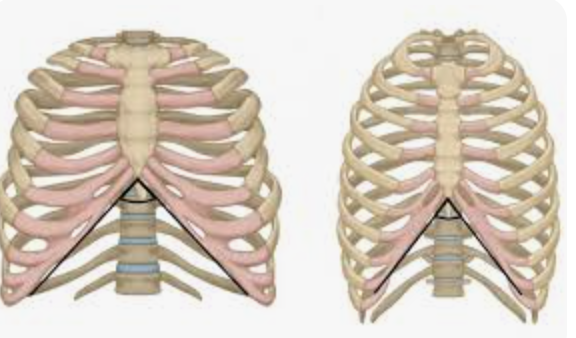
The infrasternal angle (ISA) is the angle formed by the costal cartilages of the lower ribs, and in fact is a representation of an individual’s respiratory strategy. As we all know, there are only two of them: inhalation and exhalation, which we should understand as expansion and compression. It’s a key anatomical landmark and can provide insights into an individual’s body mechanics and movement patterns. In general, we should distinguish between wide ISA (more than 100 degrees) and narrow (less than 80 degrees).
Wide ISA is the presentation of the axial skeleton in exhaled/internally rotated position (lower ribs are compensated to be able to inhale). These athletes have increased spinal curves; generally, they are stiffer and more rigid, with limitations in flexion, abduction, and external rotation.
Narrow ISA is the presentation of the axial skeleton in the inhaled/externally rotated position (lower ribs are compensated to try to push air out). These athletes have decreased spinal curves; usually, they are hypermobile, with limitations in extensions, adductions, and internal rotations.
Based on all of this, we don’t need to be rocket scientist to understand that we can’t train these two different athletes with the same approach, and this should make a huge impact on how we plan and program everything from warm-up to conditioning and to strength training.
If you are not familiar with this, I encourage you to learn about PRI (Postural Restoration Institute) and their methodology that identifies and treats postural and movement dysfunctions caused by asymmetrical muscle patterns.
- Stiff or Hypermobile Athlete
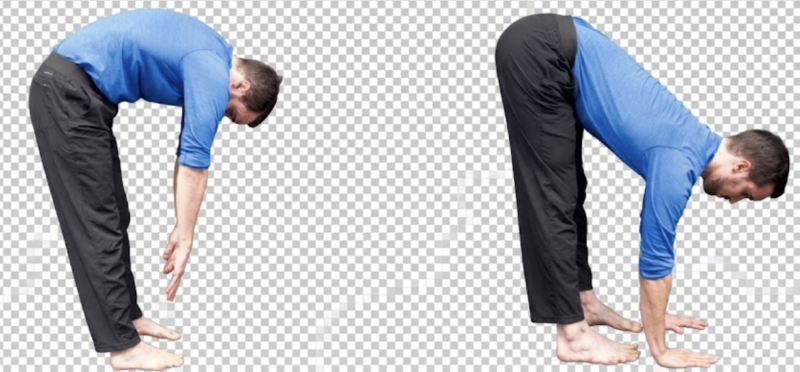
In my opinion, everybody in our industry should already understand that stiff and rigid athletes need to focus on mobility work and improving their usable range of motion, while hypermobile athletes need to prioritize stability and motor control training.
We all know that athletes need to be strong, stable, and compound on the court or field, but how much of all of this is enough, or maybe a better question is, when is too much? And that is especially important for the athletes who are missing mobility/flexibility! For example, I can train a guy who, let’s say, can lift 150kg in trap bar deadlift for 8 reps, and then we decide in the next training block we will try to increase this by 5%, so we plan everything perfectly, and at the end of this cycle, he can lift 157.5 kg for 8 reps! But now imagine his vertical jump stayed the same, the 10m sprint became slower, and his hip internal rotation, which was limited before, became even more restricted. Do you understand the point here? Instead of focusing mainly on pure force production and with this creating more system stiffness, I should try to give him a more usable range of motion to more easily express the movement potential and to learn to express force through efficient co-contraction, system tension and relaxation, coordinating better kinetic chains for more efficient transfer of energy. In this case, I would bet he would move better, recover faster, and overall feel better on the court!
To determine if your athlete falls under any of these two categories, you can use anywhere from well-standardized screens like FMS and FMSA, or you can simply do this by using a battery of assessments by checking passive and active range of motion for all major joints, like the ankle, hips, thoracic spine, and shoulders.
While doing all of this, you can already have an idea if an athlete is more geared towards rigidity or fluidity, and if you notice someone has a good or above average flexibility/mobility level, I suggest you do the Beighton joint hypermobility screen to determine if there is a case of joint laxity, especially with female players.
3. Injury History

Athletes with a past injury are at higher risk of re-injury or new injuries; they tend to create more muscle imbalance syndromes with postural dysfunctions compared to those with no prior injuries. Moreover, the single best predictor of future injury is a previous injury; this is likely due to a combination of factors, including incomplete healing, altered movement patterns, and psychological factors.
Because of this, when planning for athletes with a history of injury, the program must include a strong pre-rehabilitation component, which, whenever possible, should be developed in collaboration with the medical team.
With these kinds of athletes, we should always adapt training plans around their injured areas. Let’s take an example, if someone has lower back problems throughout their career doesn’t make sense to overload their back with a lot of jumping, heavy back squatting, and /or RDLs! A far better approach would be to keep adequate core strength, good mobility of the hips and thoracic spine, with domination of split stance and single-leg work while training in the gym.
4. Developmental Stage – Train the Athlete in Front of You
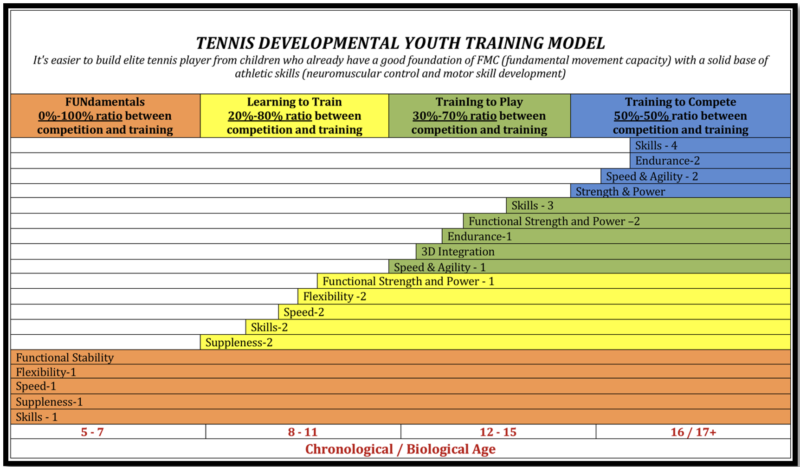
I hope we all understand that it is not the same if you train an 18- or 33-year-old tennis player! Training a youth athlete is wildly different from working with an experienced pro player. Youth athletes need more quantity work, adjusted to specific age and windows of opportunities; they need strength foundations, speed mechanics, and conditioning. Planning for older players is more about managing their training versus competitions; they absolutely need more individualized quality work, pre-rehab, and soft tissue management with a less-is-more approach outside the court. Planning must respect the developmental stage—not just in terms of biological age, but also the training age.
While planning sometimes can be identical for, let’s say, top- and low-level or young athletes, programming (volume-intensity-frequency) can be completely different. When I look at my plans, they are quite similar for all players regardless of age or level. On the other hand, training density, durations, exercise selections, and intensities are very adaptive and appropriate to the athlete in front of me.
- Force Plate Profiles – Data That Matters
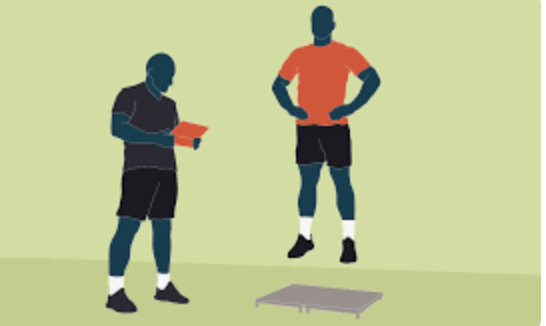
These extremely sensitive platforms are equipped with sensors that capture the forces applied during activities like standing, walking, running, or jumping.
By measuring ground reaction forces, force plates can help analyze jump performance, gait, and other dynamic movements, providing valuable insights for performance enhancement and injury prevention. In essence, force plates provide objective data about how an individual interacts with the ground, allowing for a more detailed understanding of their movement and performance. When testing CMJ, we are using general athletic movement to assess general physical qualities.
Between other things, a force plate gives you information if your athlete is a force-dominant or velocity-dominant, does he struggle to produce force quickly, or absorb it eccentrically, in essence, force plates show you where the athlete is located on the strength-to-speed continuum. This information can guide your entire approach: from strength training approach to power or plyometric progressions! Another advantage of force plates is when you work with an injured athlete, it can give you valuable info during the return-to-play protocol.
- Physical testing results
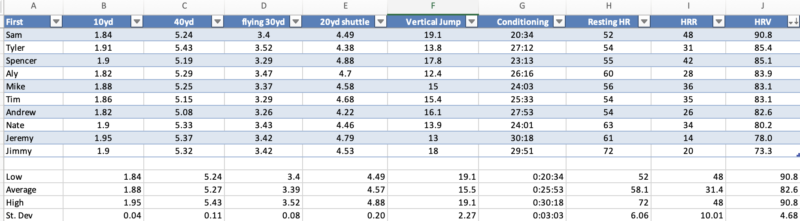
Approach to physical testing should focus on a detailed evaluation to understand the athlete’s strengths and weaknesses. This involves assessing various physical qualities like movement capacity, endurance, speed, agility, strength, and power. The goal is to create personalized training plans and programs that address individual needs and maximize results. Baseline tests help players optimize their performance by addressing areas that need more improvement. From my experience, the best athletes always strive to work on their weaknesses to maximize their overall performance potential.
So, there you have it. Six key pillars for smarter tennis training: Infrasternal angle, mobility type, injury history, developmental stage, force plate profiling, and fitness gaps. Whether you’re a coach, a trainer, or even a player yourself, this is how you should be thinking whenever you decide to make a training block to increase the level of performance!