

To Squat or Not to Squat: Strength Training Considerations for the Tennis Population
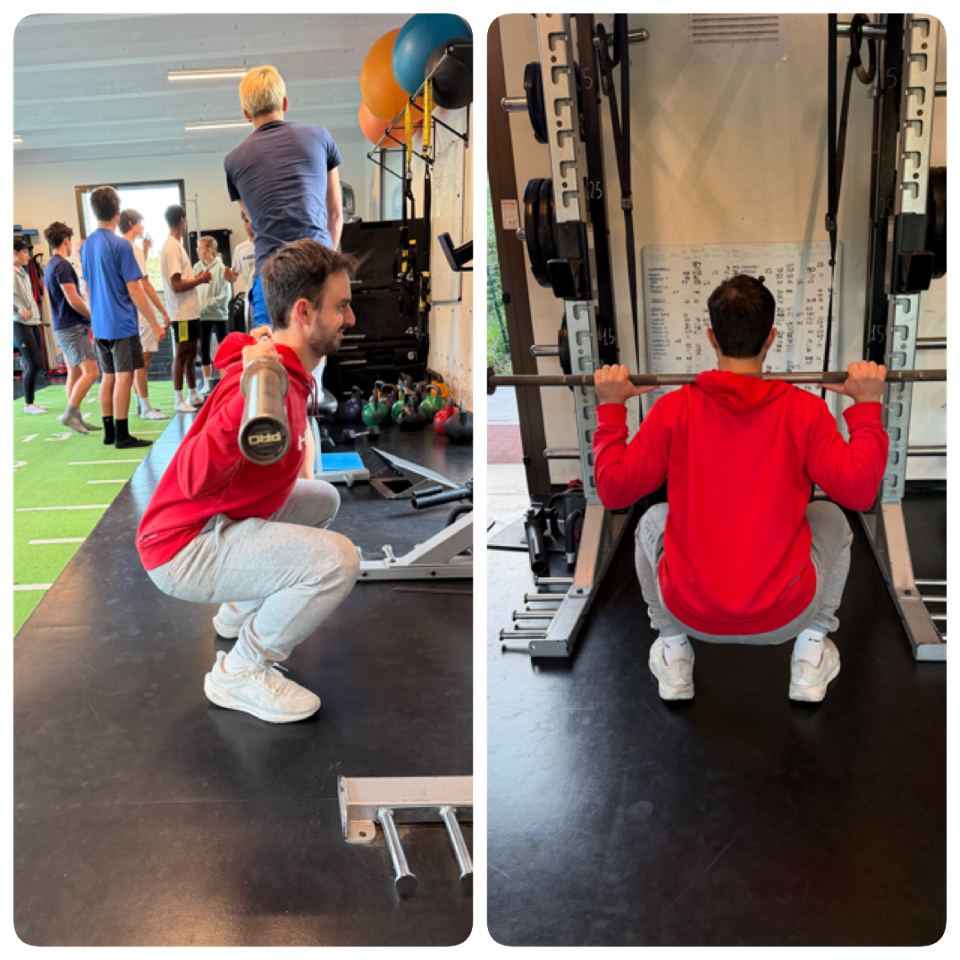
Few exercises spark as much debate in tennis strength and conditioning as the squat. Is it essential for performance? Is it risky for shoulders, knees and backs? Should juniors squat at all? And what about players with limited mobility, or the hypermobile ones?
The truth, as usual, sits somewhere in the middle. The real question for tennis players isn’t “Should we squat?” but rather “How, when, and which type of the squat?”
When deciding what type of exercises under squat umbrella we are choosing for tennis players, we need to take few things into consideration!
Let’s break it down.
1a. Back squat – bar position for internal impingement
Almost every overhead athlete during their career has internal impingement problems, so my way of thinking is to try to avoid every kind of exercises in the weight room that can provoke this symptom. This is the main reason why we inside Piatti Tennis Center don’t back squat our tennis players.
Internal impingement (posterosuperior impingement) is diagnosis most common in overhead athletic population. In the late cocking phase of tennis serve – which involves external rotation and abduction – the humeral head tends to translate superiorly (up) and anteriorly (forward) relative to the scapula.
When there is poor scapular control, weakness of the rotator cuff, insufficient thoracic mobility, loss of tissue extensibility around the shoulder (latissimus dorsai), the end result over time can become biceps tendon inflammation, labrum tear, rotator cuff muscles strain, glenohumeral ligaments thickening.
Moreover, when bar sits on the upper back, these position can cause the rotator cuff tendons to become compressed between the humeral head and the glenoid rim. If there is present even minor mobility limitations (tight lats or pecs or limited thoracic mobility) body may compensate by over-extending the shoulder joint (humeral head forward translation) to reach to the bar, further increasing impingement risk
1b. Back squat – spine compression with shear forces
Back squats apply axial loading, which naturally compresses the intervertebral discs. While often feared, this compression is a normal part of weightbearing and can stimulate disc health and bone density when managed correctly.
Spinal compression turns from a strengthening stimulus into an injury risk when mechanics fail:
- Neutral Spine Loss: Rounding the lower back (butt wink) or excessive arching under load can (lumbar lordosis)cause discs to bulge or herniate. Be mindful what is athlete posture when is just standing or walking! Is his/her pelvis anteriorly tilted, is the weight distribution shifted forward on the toes, what about lower ribs – are they in over externally rotated (inhaled) position. Putting bar on the back and squat can aggravate these postural imbalances and on a long-term cause different problems.
- Shear Forces: Excessive forward leaning during squat is dysfunctional movement pattern where the torso tips forward excessively, moving out of alignment with the shins. It indicates poor trunk/hip control, often caused by tight calves/hip flexors or weak core/hip extensors. It causes inefficient, higher-risk squats, by increasing shear stress on the lumbar vertebrae.
Tennis is a rotational sport, the rotation capacity is coming from the hips and the spine, with back squatting under load we can compromise this rotational capacity! Why would we do this from a long-term perspective?
“When increasing compression throughout the body, the “side effect” is reduced mobility somewhere in the system!”
2a. Front squat – bar position and acromioclavicular (AC) joint
Front squats require the barbell to rest across the front deltoids and clavicles, demanding significant shoulder mobility and thoracic extension. This set-up creates pressure across the shoulder girdle and especially, there is a direct pressure on AC joint.
Acromioclavicular (AC) joint injuries are a significant source of shoulder pain in the tennis population, contributing to the 17% of total tennis injuries that affect the shoulder. While often associated with direct, high-impact contact sports, AC joint pathology in tennis is frequently driven by the chronic, repetitive stress of overhead motions, such as serves and smashes.
And, since this is in many tennis players an injury that we’re just “waiting to happen”, when training in the gym we need to find training solutions to not provoke it.
2b. Front squat – rack grip
If you are using rack position to hold the bar, big “problem” with front rack position for overhead athletes is humeral anterior glide together with significant pressure on elbow and wrist joint.
Because of the positioning of the bar, elbows must reach forward, which can cause the shoulder joint to glide forward on the socket. You may also see the head shoot forward.
Rack grip puts excessive demand on wrist-elbow-shoulder mobility, this kind of grip we should avoid! I don’t find any reason why to put these already highly stressed joints in tennis population, under additional thrust type of stress outside the court.
As you can see on the photo, I don’t have adequate mobility in the shoulder and wrist to hold empty bar in the rack position. Imagine amount of stress on this articulations with additional weight put on bar.
Which type of squats make sense for tennis players
There is a lot of other options if you want to load tennis player in bilateral squat stance. Anywhere from Goblet Squat, Hexagon Bar squat or Isoinertial Belt Squat, with every of these variations there is significantly less stress on the spine, shoulder, elbow and wrist even if you load them heavy.
When we are talking about squat the goal should be—performance and durability, not powerlifting numbers.
Tennis Is Unilateral—Training Should Reflect That
Most tennis actions happen on one leg at a time: lunging, pushing, decelerating, and rotating. This is why we should prioritize single-leg strength alongside (or sometimes instead of) bilateral squats.
Effective alternatives include:
- Split squats
- Lateral lunges
- Step-ups
- RFESS
These variations:
- Address side-to-side imbalances
- Reduce spinal loading
- Improve pelvic and hip stability
- Better mimic on-court demands
That doesn’t eliminate squats, it gives you variation for players that doesn’t have appropriate mobility, stability or motor control to execute biomechanically correct squat pattern!