

Shuffle vs. Crossover Step in Tennis
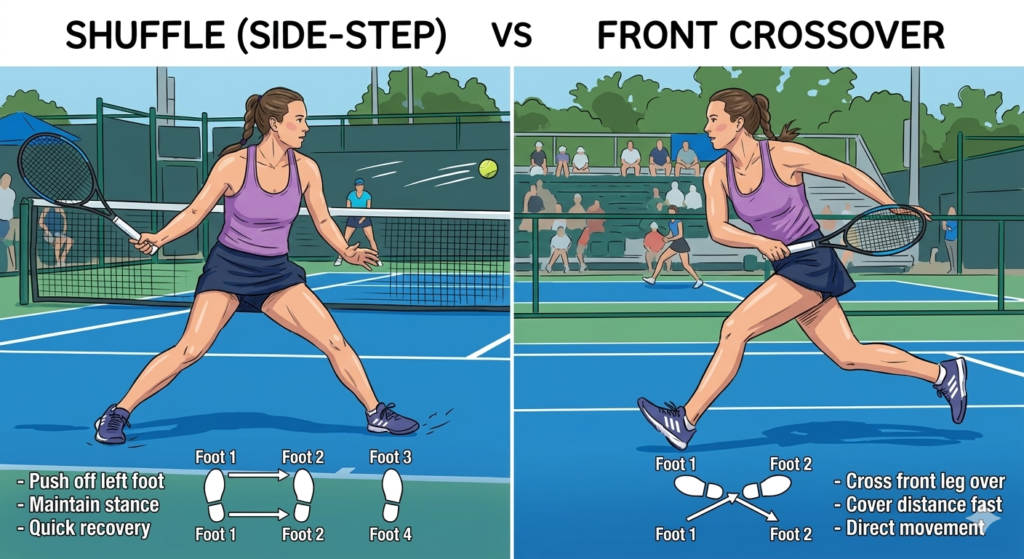
Few days ago, I received a question from one of my colleges in the Piatti Tennis Center about when to you use shuffle versus crossover steps.
Below I’m sharing with you, my answer.
In tennis, shuffle steps and crossover steps are well known footwork patterns, which are used in different situations depending on distance from the ball, time, and balance needs.
A simplistic way to think about these two different movements strategies is:
“Crossover to get there, shuffle to hit”
Shuffle
Shuffle is used when you need control more than speed, using smaller, choppy movements to be able to:
- Maintain athletic posture and lower center of mass
- Stay reactive
- Make short, controlled micro-adjustments to the ball
- Staying balanced for stroke preparation
- Be ready to stop, change direction, or hit
- Maintaining court positioning
When coaching shuffle both on and off court these are few of the best cues:
- Push away the court
- Stay in the tunnel
- Quiet feet before contact
Common mistake on tennis court is when players are over-shuffling to chase wide balls and therefore there is a late contact, rushed swings and often players find themselves in poor balance before hit
Crossover
Crossover is characterized by separation between the shoulders and hips, where the lead leg crosses over the trail leg allowing the hips to rotate and generate more force.
By doing so player gain ability to:
- Cover distance more quickly
- Gain speed and momentum
- Quickly recover the court
Tennis examples of using crossover are when moving to a wide forehand,
Recovering back to center after a stretch or when chasing down a deep cross-court ball
Crossover coaching tips are:
- Open the hip and drive
- Separate the hips from the shoulders
- Hips stay at the same line
Summary
Based on that, players should use:
Shuffle = reaction + readiness / distance from the ball 0-2 meters
Crossover = speed + effort / distance from the ball 2+ meters
This correct sequence is:
- Split step
- Read the ball
- Crossover to cover distance
- Shuffle to fine-tune
- Load → hit
However, reading the opponent’s shots and the trajectory of the ball is fundamental thing (I see here the biggest difference between good players and high-level ones). Being able to anticipate and decide which type of movement to use to put yourself in the best position to hit is a clear advantage!